Running While Chained
On Samia, NoteSpeak, and the Art of Bearing Witness

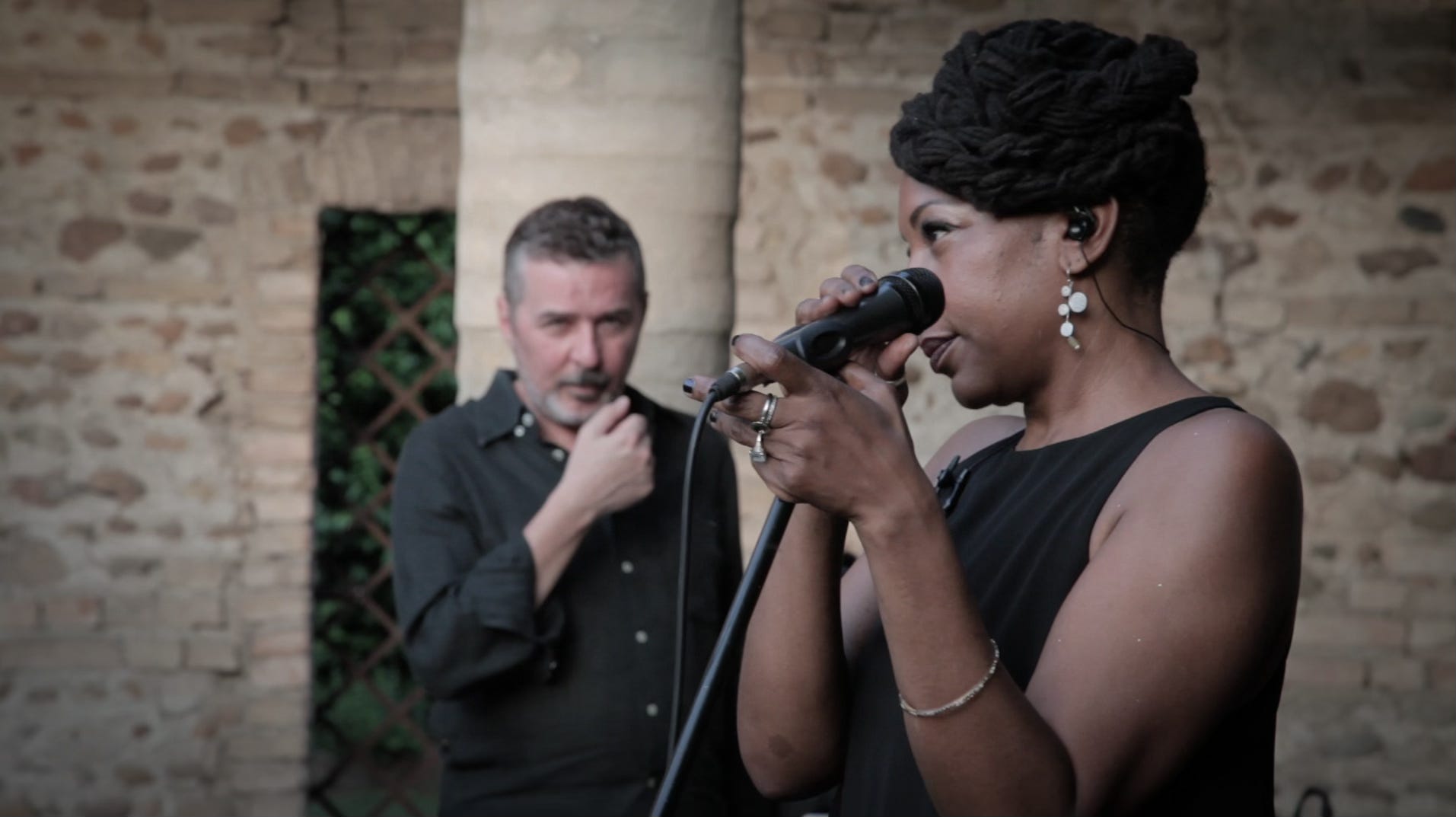
A Note Before We Begin
Several of you asked for the story behind Samia, from the first NoteSpeak album, NoteSpeak (Amori e Tragedie in Musica). I mentioned it in passing in the last post, and your curiosity moved me. This is not the next chapter in the series about the new album, NoteSpeak (In a Word), the third in the trilogy, but it belongs here, now, because you asked, and because Samia’s story deserves to be told as often as possible.
So we are going back. All the way to a late night, a couch, a television, and a young woman running.
Learning about Samia
Samia Yusef Omar
faster faster faster faster
(The voiceover for this post includes excerpts from the song itself. If you’d like to hear the lines as they were performed, you’ll find them woven into the recording.)
When you hear the audio, you will hear me repeat her name almost as a prayer, an invocation, a lament. Some names carry entire histories inside them, and the only thing to do is say them aloud, again and again, until the world understands what it lost. The “faster faster faster faster” that follows lives in that same tension; it is Samia’s own hunger, her fierce, uncontainable ambition to push beyond every limit her body and her circumstances had ever known, and it is also the cruelest possible irony, a world that demanded she hurry while methodically removing every road she could run on. Her desire and the world’s indifference occupy the same breath.
I came home late from a gig, still carrying that peculiar electricity musicians wear home after a show, the hum of it still in our hands, our throats, the soles of our feet. I turned on the television the way you do when you’re too wired to sleep and too tired to think.
The documentary was about Samia Yusuf Omar, a Somali sprinter who had competed in the 200 meters at the 2008 Beijing Olympics. She was seventeen years old. She trained on a gravel track pocked with mortar craters, in a stadium in Mogadishu, doing all she could to evade harassment from militants who believed Muslim women had no business running at all. She competed in equipment donated by the Sudanese team because Somalia had no funding to provide her with her own. She finished her heat more than nine seconds behind the other runners, in last place, alone on the track.
And the entire stadium rose to its feet.

One journalist who was there said he got goosebumps. Another reported that she received a louder cheer than the gold medallist. I was sitting on my couch after midnight, still in my stage clothes, and I was undone.
How you flew
running while chained
you maintained every hope as you trained
your eyes on the pinnacle.
The Olympic
Inspired, some would say even mystic
Your name is a mantra for all women oppressed
The nature and means in which you went about your quest
can only attest to your grandeur.
How you flew
“Running while chained” is a compressed metaphor, one image holding the physical and the political simultaneously, the literal chains of a society that criminalized her ambition alongside the visceral fact of her body moving through space at full speed anyway. But the poem refuses to let the chains have the last word. It keeps returning to “How you flew”, insisting on flight, on grandeur, on the fact that what she did was magnificent. The chain is the context. The flying is the truth.
What Came After
After Beijing, Samia went home to Somalia, where Al-Shabaab had banned women from sport entirely. By 2009, she and her family were living in a displacement camp outside Mogadishu. In 2011, she fled to Addis Ababa, alone, leaving her family behind, chasing the dream of competing at the 2012 London Olympics.
Searching for a coach, she traveled north toward Europe, crossing the Sudan into Libya, where she was imprisoned. In April 2012, she boarded a packed boat with seventy other people, trying to cross the Mediterranean to Italy. The boat ran out of gas. When an Italian Navy vessel arrived and threw ropes over the side, the ensuing chaos knocked Samia into the sea.
She was twenty-one years old. She could see Italy’s coast.
Somalia to
Ethiopia
Sudan to
Libya
arrived in Tripoli then
headed for Europe entry by Italy
almost there, the very last leg,
I read this passage in performance exactly as it looks on the page: speeding up, my breath getting shorter, each country a border crossed, each line a door that opens and closes. The form enacts the journey. The white space between each name is a desert, a prison cell, a stretch of open water. The silence after that final comma is where Samia is.
I was dumbfounded at the sheer magnitude of what the world had lost. Not just Samia, though Samia herself was immeasurable, but every unrealized version of every person making that crossing. How many athletes, doctors, engineers, musicians, teachers, the whole cathedral of human potential, simply swallowed by water? The tragedy is almost too large to comprehend, which is perhaps exactly why it needs a poem.
I sat down, in tears, that night and wrote the bones of what would become “Samia”.
How NoteSpeak Was Born
To understand why I chose to speak the poem rather than sing it, and why Marco’s composition wraps around it the way it does, you need a little context about how NoteSpeak came to exist at all.
Marco Cremaschini and I have been writing partners for more than a decade. Our band, Hippie Tendencies, was the constant throughout, and on those albums, the songs were sung, rooted in jazz but genre-fluid enough that audiences would listen to a full show and then ask, a little bewildered, what exactly we called this music. I wrote a song about that, actually, called “Poppy Rock”, but I digress.
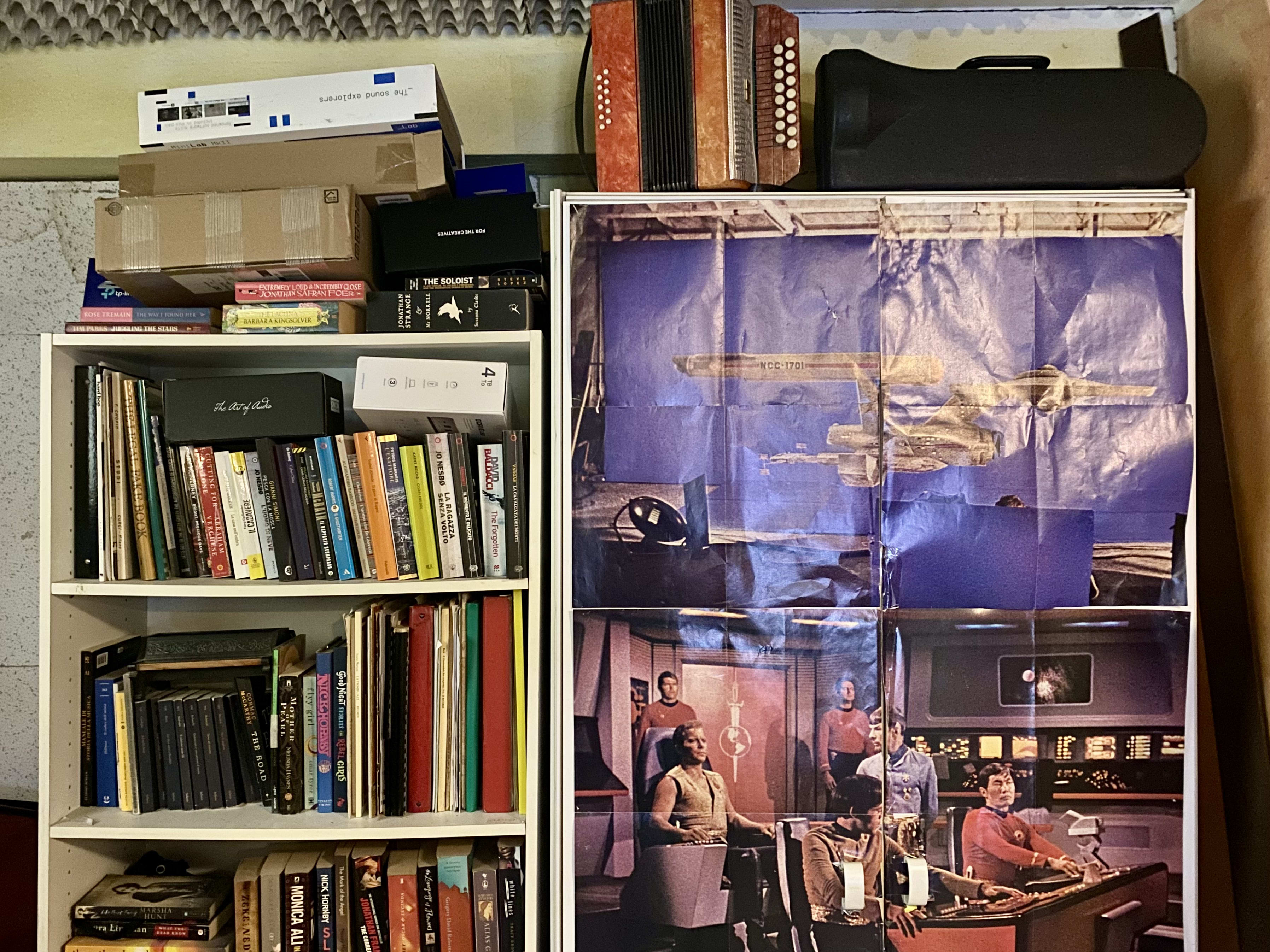
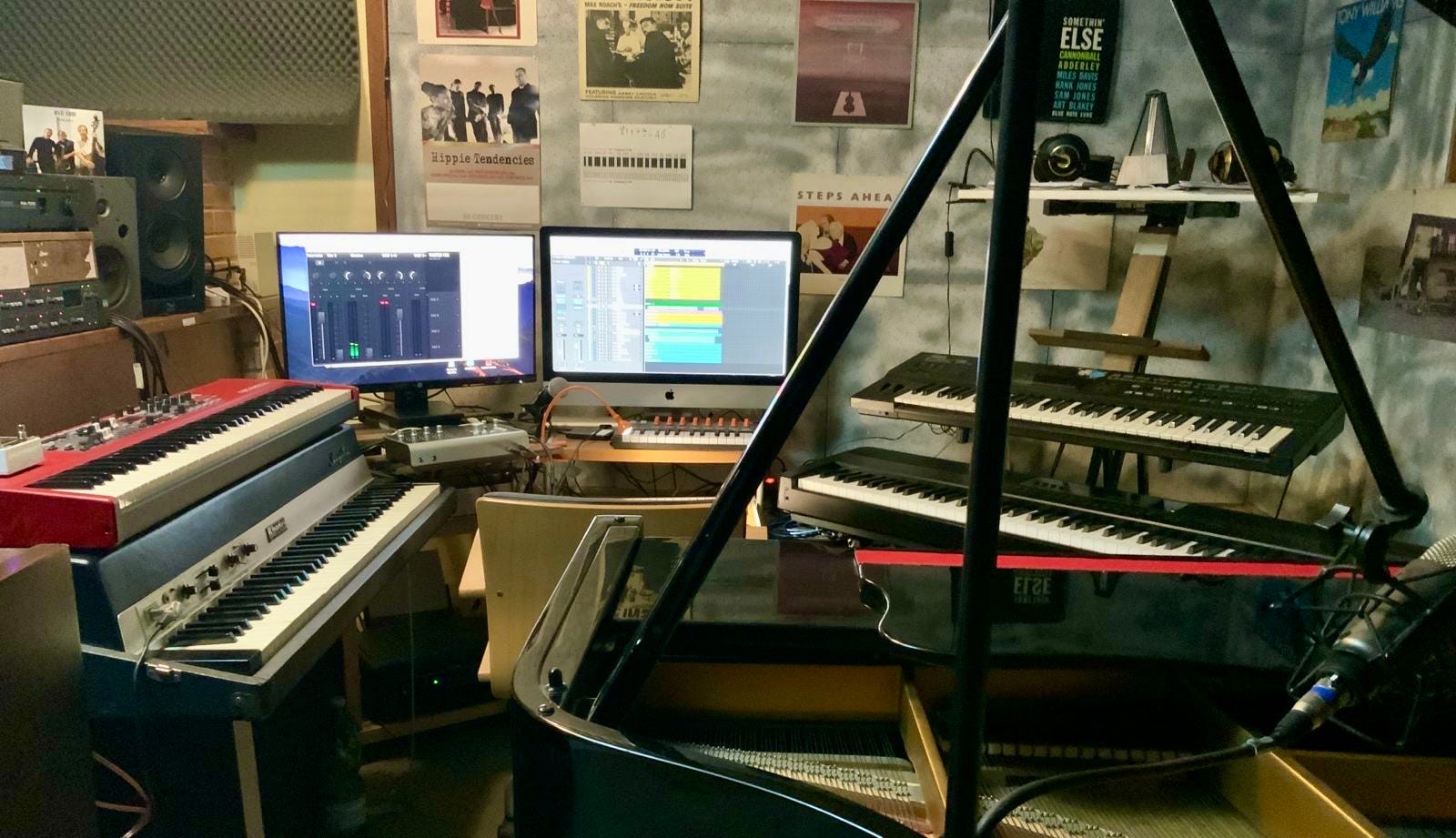
He works two floors below me, in our home studio/spaceship, which is filled to bursting with the baby Schimmel, the Hammond, the Rhodes Suitcase, guitars, drum kit, and more keys of every kind imaginable. He soundproofed the walls and covered them with old album covers and vintage Star Trek posters, original series only, nothing else would do. Atmosphere for his own cockpit.
.
My study is at the very top of the house, walls I painted deep brick red the week we moved in, womblike and warm, a room that indulges every bohemian fantasy I have ever entertained. Those were literally our priorities in an empty house.
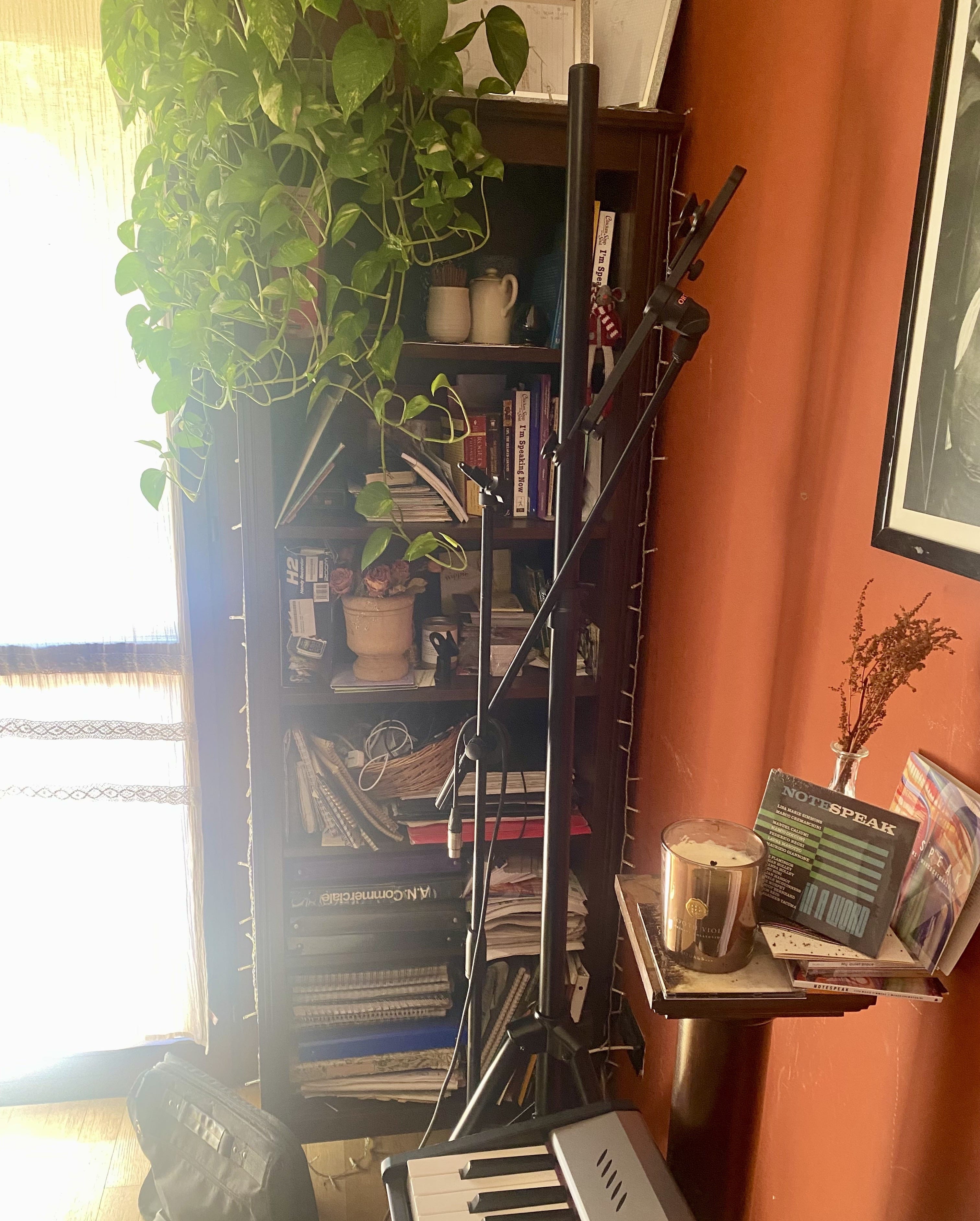
I write, he plays, and the faint strains of his sometimes melancholic, sometimes raucous, always sublime notes provide the soundtrack to my days. We meet at the dinner table and compare notes. He is always my first reader. I am always his first listener. Marco is as committed to realizing himself fully as pianist and composer as I am committed to growing every day as a writer. The execution of our disciplines defines us; it is as comforting as it is inspiring to have his company.
The shift from singing to speaking happened gradually, then all at once. On Hippie Tendencies’ second album, we had been working with a piece combining two songs from Joan Baez and Ennio Morricone’s soundtrack to Sacco and Vanzetti, those famous letters written by Bartolomeo Vanzetti to his father and to Nicola Sacco’s son as they waited to be executed. We were struck by the parallels between their story and an Italian amnesia around intolerance that persists today. We decided that rather than adapting the vocal melodies, I would not sing the song. I would speak it, shout it, proclaim it.
It became one of the most requested songs at every H.T. show we played. Something had cracked open.
The writing process of that H.T. album continued to be revelatory. While I was primarily the wordsmith and he the melody maker, we were both happy to exchange roles from time to time. Marco began moving toward spiritual jazz, incorporating electronic instruments, building compositions that could transform with every live performance. I was upstairs, agonizing over every word in the day’s poem. The two disciplines began to find each other. When I gave him the poem “A Fazioli” to read, he immediately composed an accompanying piano score. The day we recorded the demo, the alchemy of listening to each other, his hands on the keys, my voice in the room, felt like the deepest kind of magic. From the first take, we reached the end of the road perfectly in synch, with none of the usual musical signposts between us.
NoteSpeak began with that.
The Permission to Tell Her Story
After I wrote the bones of Samia, I did what the poem demanded. I researched meticulously. I reached out to author Giuseppe Catozzella, who wrote Non dirmi che hai paura (Don’t Tell Me You’re Afraid), a book that tells Samia’s story. He was generous and kind, and he put me in touch with Samia’s sister. I asked her permission to tell her sister’s story, and she granted it.
That yes is the weight the poem carries. Every time we perform this piece, Samia’s sister is in the room. The stadium in Beijing is in the room. The seventy people on that boat are in the room. The coast of Italy, close enough to see, is in the room.
A poem cannot bring anyone back. But it can refuse to let them be forgotten. It can insist, in its small, persistent way, that the world remember who it lost and what it cost.
Radiating star
shooting through the darkness
look down shine the path to take
lead on we will come
This is the refrain, and it is the only part of Samia that is sung rather than spoken. The poem shifts register here, moving from elegy to invocation, from mourning to instruction. It stops looking back and starts looking up. “Lead on, we will come” is a promise, and it needed a voice equal to the weight of making it.
That voice belongs to Machan Taylor, and how she came to sing it is its own small proof that community announces itself when the moment is right.
Machan is a singer and composer whose career reads like a map of the finest music of the last four decades, touring with Pink Floyd, performing with Aretha Franklin, Sting, and Billy Joel, recording with Gov’t Mule, and teaching at NYU and The New School. She was in Italy for a gig and eating at one of my local hangs. When I walked in, the owner of this, my favorite local restaurant, decided we needed to meet. We ended up at the piano together that same evening, laughing and singing. Kismet has a logic all its own.
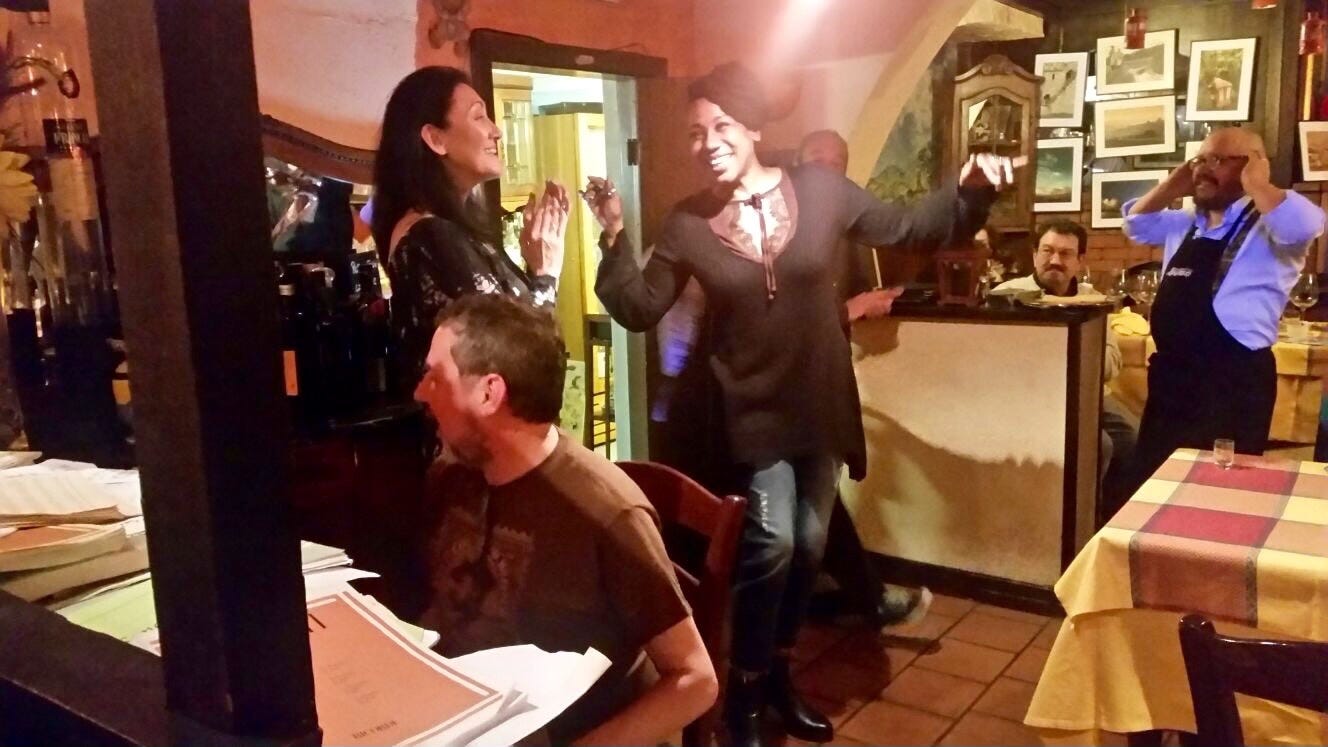
I sent her Samia. She said yes immediately, and she sang it hauntingly, which is the only word that comes close. Her voice in that refrain inhabits grief, and then, astonishingly, lifts it.
Each song on NoteSpeak has its own anecdote. Some started with the poem, some began with Marco’s music, but from the outset, we were dedicated to ensuring they were one entity. Not poems with background music. Though the music could certainly stand alone, as well as the poems, their worth is exponentially greater when entwined, just as our lives are.
Next up in the musical series, back to NoteSpeak (In a Word), I promise. But next week, we're going to Louisiana. I had sworn, categorically, that the Deep South was not for me. Shirley had other plans.
From the NoteSpeak (In a Word) series:
NoteSpeak (In a Word) - Refrain #13

“Shaping the Yet-to-Be” is the second track on the album, the tenth poem I wrote, and apparently the one that’s most conducive to haunting people’s Instagram stories. Catherine Wood, interim director of Tate Modern, used it as the soundtrack for her 2027 exhibition announcement. Which is wild and wonderful, but also makes sense, because this song is about exactly what curators and artists do. We imagine a future into being, then build the framework to support it.
P O W E R F U L!! My soul shook when you said, “A poem cannot bring anyone back. But it can refuse to let them be forgotten. It can insist, in its small, persistent way, that the world remember who it lost and what it cost.”
This is so powerful. I was unaware of her. I love the layers of Joy in this as well — the photo of Adriano is incredible. Incredible post.